Mangamo Manga & Comics
- 3.6
- Rating
- 500.00K
- Installs
- Free
- Price

 Analysis by App-foxy
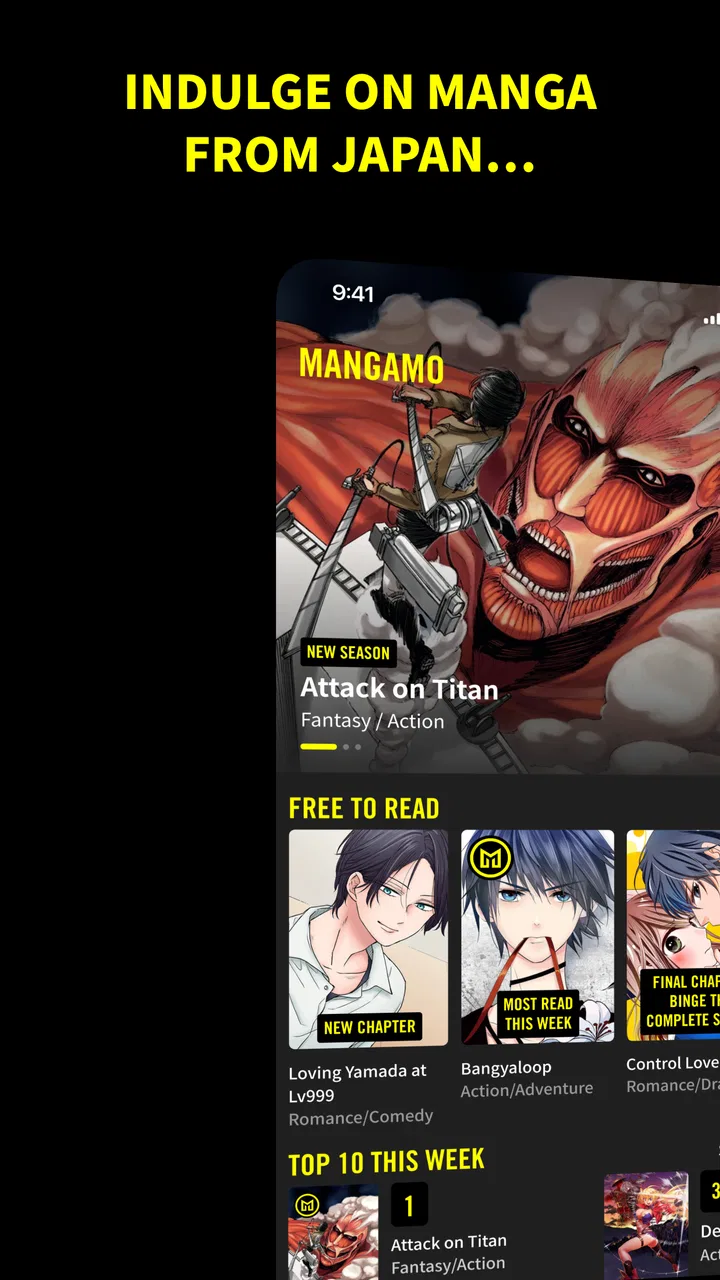
I found Mangamo Manga & Comics most interesting when I treated it less like a simple reading shelf and more like a connected gateway to licensed Japanese comics. The appeal is immediate: the app brings officially published manga to a phone, including Attack on Titan, and keeps the experience focused on reading rather than on social feeds or unrelated entertainment. In my hands, that focus made it easy to open the app during a short break and continue with a series without carrying a physical volume.
That convenience comes with an important condition. Your reading experience is tied closely to the quality of your connection and to how comfortably you can use a phone for long stretches. I would recommend it to readers who want legitimate manga access in a mobile format and who are happy to manage their reading around connectivity. I would be more cautious about recommending it to someone who expects every title to behave like a permanently stored ebook or who mainly reads in places with unreliable service.
How Mangamo fits into everyday manga reading
Mangamo is a comics app from Mangamo, and its main identity is clear: it is built around officially published manga titles from Japan. That distinction matters to me because the reading experience feels more purposeful than browsing an unstructured collection of scans or relying on questionable sources. The app is free to install, while in-app purchases range from $1.99 to $199.99 per item, so the practical cost of using it depends on how deeply you engage with its available content.
You May Also Like

 Blood Strike: 2.5 Anniversary
Blood Strike’s Loadouts Turn Every Drop Into a Tactical Gamble
A close look at Blood Strike’s custom loadouts: how fast access to signature weapons reshapes its battle royale rhythm, rewards preparation, and narrows the gap between fights.

 Pandora - Music & Podcasts
Pandora’s Music Is Easy to Start, but Harder to Recover
Pandora’s strength is its low-effort path from a seed to a station. Its weak spot is how much confidence it asks you to place in connection, setup, and quiet recovery.

 8 Ball Pool
 Is Built on Rivalries, Rematches, and Routine
A close look at the rivalries, rematches, shared routines, and unanswered safety questions that turn a quick pool match into a persistent mobile community.

 Samsung Music
’s Quiet Strength Is Playing What You Already Own
Its reach comes less from spectacle than from dependable access to a personal library. That simplicity is both the app’s strongest retention engine and its ceiling.

 AccuWeather: Weather Radar
AccuWeather Review: A Quick, Clear Forecast for Everyday Decisions
For everyday plans, the best forecast is the one you can understand quickly. AccuWeather makes rain timing, radar, and local conditions easy to act on, with a few trade-offs.

 Hill Climb Racing
Why Hill Climb Racing Still Turns Crashes Into One More Run
A tiny car, a bumpy hill and one more upgrade: Hill Climb Racing keeps resurfacing because its simple chaos makes every near-miss feel personal.
More From Our News Desk



The app sits in the Comics category and is suitable for Teen users. It has been available since November 22, 2020, and the current version is 1.228.0. Android support reaches back to version 7.0, which makes it approachable for people who are not using the newest phone. Its audience is already substantial, with over 500,000 installs, although the average rating of 3.7 from around 1,500 ratings suggests that the experience is useful but not universally smooth.
I would not read that rating as a reason to dismiss the app. Manga applications can receive mixed reactions for reasons that have little to do with the quality of the comics themselves, including catalog expectations, account or purchase friction, device differences, and connection problems. Instead, I see it as a reminder to approach Mangamo with realistic expectations: it is a convenient digital reading service, not a replacement for every possible manga source or for a complete physical library.
Why the connection changes the first impression
The strongest network-dependent moment comes at the beginning of a reading session. Opening a title, moving through the catalog, and getting to a chapter all rely on the app communicating with its service. With a stable connection, that process feels natural. With an unstable one, even a short reading break can become a sequence of waiting, retrying, or deciding whether it is worth continuing.
This is especially noticeable because manga pages are visually dense. A page is not just a small text panel that can appear instantly without affecting the experience; it contains artwork, speech bubbles, sound effects, and carefully arranged pacing. When the connection interrupts the flow, the problem is not merely technical. It can break a reveal, weaken a joke, or make an action scene feel disjointed.
For that reason, I prefer to open the app before I am already in a hurry. If I am waiting for an appointment, I give myself a moment to browse and begin a chapter while the connection is dependable. That small habit makes Mangamo feel much more reliable than opening it at the exact moment a train is leaving or a signal is fading.
There is also a difference between browsing and reading. Browsing can involve several images, cover designs, and catalog screens in quick succession, while reading concentrates on the pages of one chapter. If your connection is limited or inconsistent, I would avoid repeatedly jumping between titles just to compare them. Choosing a series first and staying with it creates a steadier session and reduces unnecessary loading.
Using it during commutes, breaks, and travel
Mangamo makes the most sense in mobile situations where you have a phone in hand and a reasonable connection nearby. I can imagine using it during a lunch break, in a café, or while waiting for a friend. The screen is small compared with a tablet or printed volume, but it is always available, and that changes how manga fits into the day. Instead of planning a long reading session, you can use several small gaps of time.
A realistic example would be a reader commuting by bus. At home, they choose a series and check that the app is responsive. During the ride, they read while the signal remains consistent. If the route passes through a weak-service area, they stop at a natural page break rather than forcing the app to keep up through the interruption. That approach sounds simple, but it protects the reading experience from becoming frustrating.
For longer sessions, I prefer a larger display. A phone works well for a few chapters or a quick continuation, but detailed artwork deserves room. On a small screen, I may need to zoom mentally by concentrating harder, even when the page itself is readable. Readers who care strongly about panel composition, background details, or the visual rhythm of a full page may find a tablet or physical book more comfortable.
That does not make the phone format a weakness for everyone. In fact, the compact screen can be an advantage when privacy matters. Reading on a phone is less conspicuous than carrying a large book, and the app is easier to fit into an ordinary routine. I would choose Mangamo over print when portability and immediate access matter more to me than the tactile feel of turning pages.
What happens when the network becomes unreliable
The most useful way to think about connection failure is to plan around it rather than assume the app will rescue every situation. If a chapter is slow to open, I first wait for the current request instead of tapping repeatedly. Repeated taps can make it harder to tell whether the app is working or whether several actions have been queued. I then move to a stronger signal, close distractions, and try again once the connection is stable.
If a session breaks halfway through, I make a note of the chapter and page in a simple way before leaving the app. That may be as basic as remembering the last panel or taking a personal note outside the app. The point is to create a recovery step that does not depend on the service instantly restoring the exact reading position. This is particularly helpful when I am switching between Wi-Fi and mobile data.
I also avoid treating a failed load as evidence that the title itself is unavailable. A weak connection can make catalog browsing, chapter access, and page loading appear inconsistent. My recovery routine is to verify the connection, reopen the app if necessary, and return to the same title rather than immediately searching for a different source. That keeps a temporary network issue from turning into a mistaken judgment about the catalog.
Readers should also consider what they need before entering a dead-zone environment. If you know you will be underground, on a flight, in a rural area, or somewhere with expensive mobile data, Mangamo may not be the safest choice for an uninterrupted reading plan. I would select a reading option with clearly established local-storage behavior for those circumstances. Mangamo is better suited to connected reading unless your own experience with the app and device shows otherwise.
Managing data without making reading feel like work
A manga app can use more data than a text-heavy reading app because every page is artwork. I therefore treat mobile data as a resource to manage, especially when I am not on an unlimited plan. I avoid browsing aimlessly on cellular service, because opening many covers and previews can add up without giving me much reading value.
My preferred workflow is to browse when I have Wi-Fi, decide what I actually want to read, and reserve cellular data for a focused session. I also keep an eye on how long I am reading when I am away from Wi-Fi. A short chapter during a commute is one thing; leaving a title open for hours while moving through many pages is another. The distinction is practical rather than dramatic, but it helps prevent an unpleasant data surprise.
Battery matters too. A bright screen, an active connection, and continuous image loading can make a long manga session more demanding than reading a plain text article. I lower brightness to a comfortable level and avoid starting a long session when my phone is already low. This is not a Mangamo-specific trick, but it is particularly relevant to a visually rich app used away from a charger.
There is a trade-off between convenience and control here. A physical book gives me a predictable reading object with no network dependency, while a digital service gives me portability and a broader library in my pocket. A dedicated ebook-style alternative may offer stronger local reading controls for some users, but it may not provide the same focus on Japanese manga titles or the same access model. I would choose based on where I expect to read, not just on how attractive the catalog looks at home.
Choosing it over physical books and other digital options
Compared with printed manga, Mangamo wins on portability and immediacy. I can carry a phone instead of several volumes, and I do not need shelf space. It is also easier to sample a reading service than to purchase a stack of books at once. For a reader who moves frequently or wants to keep a series available during small breaks, that difference is meaningful.
Print still has clear advantages. Paper does not depend on signal, battery, app availability, or screen brightness. The page size can make artwork easier to appreciate, and the physical act of reading is calmer for people who spend much of the day looking at screens. If I am planning a long uninterrupted session at home, I may prefer a printed volume even when the digital option is more convenient.
Compared with general comic readers, Mangamo has a more specific identity. It is not simply a place for any kind of digital comic; its emphasis is Japanese manga and official publication. That focus is valuable if your reading habits already point in that direction. On the other hand, someone looking for Western comics, graphic novels, or a single universal library may find a broader comics platform more suitable.
Compared with unofficial manga websites, the official route is the more responsible choice. I would rather use a service connected to legitimate publication than deal with inconsistent scans, intrusive pages, or uncertain sourcing. The compromise is that an official service may not match every reader’s preferred title, reading method, or pricing expectations. That is a fair trade only if the available catalog and purchase structure fit your habits.
Who will get the most from the app
I think Mangamo is a good match for a manga reader who wants a dedicated mobile experience, values official titles, and often has Wi-Fi or dependable mobile service. It is also appealing to someone who reads in short bursts rather than insisting on a long session every time. The free entry point makes it easier to explore the experience before deciding how much to spend through in-app purchases.
It can also suit families who understand the Teen content rating and are willing to supervise choices appropriately. That rating should not be treated as a promise that every title will suit every younger reader. Manga covers a wide range of themes, so I would still look at individual series and use personal judgment rather than handing over the app without discussion.
I would skip it, or at least postpone installing it, if my main requirement were guaranteed reading without a connection. I would also hesitate if I disliked reading on a phone, had very limited data, or wanted a complete collection of one particular publisher’s entire catalog. In those cases, print or another digital service may fit better. The right question is not whether Mangamo is universally best, but whether its connected, mobile-first approach matches the way you actually read.
Small habits that improve the experience
My first tip is to make the catalog decision before the rushed part of the day. Selecting a title while connected and then reading it with a clear plan is easier than searching through several series on a weak signal. This also helps control data use and avoids turning a short break into a browsing session.
My second tip is to stop at natural breaks when connectivity is uncertain. Manga often provides chapter or scene transitions that make sensible stopping points. Using them protects the story’s rhythm and gives the app a better chance to recover before the next session.
My third tip is to match the screen to the material. I use the phone for convenience and shorter sessions, but I would move to a larger display when I want to study detailed art or read for a long time. This simple choice changes my comfort more than repeatedly adjusting how I hold the phone.
Finally, I would test the app in the places where I genuinely plan to use it. A smooth home Wi-Fi session tells me that the basic experience works, but it does not answer whether the app suits my commute, workplace, travel routine, or mobile-data plan. That personal test is more useful than assuming every reader will experience the same level of reliability.
A connected reading experience with a clear boundary
After using it as a mobile manga reader, I see Mangamo Manga & Comics as a convenient option for legitimate Japanese comics, especially when I have a stable connection and want something available immediately. Its free installation, Teen rating, broad Android compatibility, and focused catalog make it approachable, while the purchase range means I should pay attention to how I intend to read before spending.
The main limitation is not the idea of digital manga itself; it is the dependence on a connected routine. Network interruptions, mobile-data concerns, battery use, and the smaller phone screen can all shape the session. None of these issues makes the app unusable, but they do mean I would not choose it blindly for travel or signal-poor environments.
My final recommendation is straightforward: try it if you want a dedicated way to explore officially published manga on your phone and your normal reading locations have reliable service. Keep print or a more locally focused digital alternative in mind if uninterrupted offline access, large-page comfort, or strict control over data is more important to you. For the right reader, the best feature is the freedom to fit manga into ordinary spare moments without relying on unofficial sources; for the wrong reader, that same mobile convenience will feel limited by the connection it needs.
FAQs for Mangamo Manga & Comics
01What is Mangamo Manga & Comics?
Mangamo Manga & Comics is a subscription-based app that provides access to a vast library of manga titles. It offers a legal and affordable way to read manga, ensuring creators are supported. Users can enjoy a variety of genres, from action and adventure to romance and horror, all in high-quality formats.
02How much does a Mangamo subscription cost?
Mangamo offers a subscription plan that typically costs around $4.99 per month. This gives users unlimited access to its entire manga library. Occasionally, there are free trials or promotions. It’s advisable to check the app or website for the latest pricing and subscription offers.
03Does Mangamo offer offline reading?
Yes, Mangamo allows users to download manga for offline reading. This feature is especially useful for readers who want to enjoy manga on-the-go without worrying about internet connectivity. Simply download the desired chapters while online, and access them anytime, anywhere.
04Is Mangamo available on both Android and iOS?
Mangamo is available for both Android and iOS devices. Users can download the app from the Google Play Store or Apple App Store, making it accessible to a wide range of smartphone and tablet users. The app is regularly updated to improve user experience and add new features.
05Can I read Mangamo on multiple devices?
Yes, with a Mangamo subscription, you can log in and read manga on multiple devices. This feature is ideal for users who prefer to switch between their smartphone, tablet, or other devices. Ensure you use the same account to sync your reading progress across all platforms.
Pros
- Wide selection of manga titles.
- High-quality images and interface.
- Offline reading available.
- No ads to interrupt reading.
- Regular updates with new chapters.
Cons
- Subscription required for full access.
- Limited free content available.
- Occasional loading delays.
- No option for vertical scrolling.
- Some genres less represented.

Mangamo Manga & Comics
Gallery